
Hydrogen Data
I. Causes of Ageing and Disease
Causes of Ageing and illness?
To review the recent research results, we can summarize the following 3 points.
1. The basic cause of Aging and illness is due to cell damage.
2. The cause of cell damage is harmful oxygen free radicals.
3. 90 % of all diseases are caused by harmful oxygen free radicals as a major cause of Cell Damage.
→ Cell damage due to harmful oxygen free radicals is the major cause of aging and disease
Representative diseases caused by harmful oxygen free radicals
Department Representative diseases
Circulatory system/ Respiratory organ myocardial infraction, artery hardening,
pneumonia, angina
Brain-nervous system cerebral infarction, epilepsy, cerebral haemorrhage, Parkinson's disease,
autonomic disturbance
The digestive system gastritis, stomach ulcer, cancer of the stomach, cirrhosis, Crohn's disease,
pancreatitis
Hematometer leukemia, septicaemia, hyperlipidemia
Endocrine system diabetes, adrenal, disturbances of metabolism
Integumentary System atopic dermatitis, dermatitis solaris,
photosensitivity disease
Dermatitis cataract, Retinal degeneration
Tumor system cancer caused by smoking, chemical carcinogenesis, radiation cancer
Connective-tissue system articular rheumatism, auto-immune disease,
collagen disease
* All diseases (90%) are affected by harmful oxygen free radicals. About 10% of them are caused by bacterial and viral diseases or infections.
* Germ diseases increase faster in the interior of the body when harmful oxygen free radicals increase – Johns Hopkins University School of Medicine, 1991
What are harmful oxygen free radicals?
The breathing oxygen around 2 ~ 3% turns into oxygen free radical, which produces good active oxygen and Harmful oxygen free radical.
※ Breathe more than 20,000 times a day on average, more than 1 million liters of air is released through the respiration, and oxygen absorbed by double breathing is about 1500 liters, In other words, Our body produces oxygen free radical of 30 liters every day. (Gale Encyclopedia of Medicine, 2008) –
There are 4 types of oxygen free radicals (Superoxide radical, Hydrogen peroxide, Singlet oxygen, Hydroxy radical)
1. The basic cause of Aging and illness is due to cell damage.
2. The cause of cell damage is harmful oxygen free radicals.
3. 90 % of all diseases are caused by harmful oxygen free radicals as a major cause of Cell Damage.
4. The hydroxyl radical is the most active one causing cell damages of those oxygen free radicals.
Ⅱ. How to defend Harmful oxygen free radical
As described earlier, How to remove Harmful oxygen free radicals is the most important task to cope with aging and disease. How to effectively remove Harmful oxygen free radicals?
Oxygen free radical’s defensive function
1. Superoxide dismutase (SOD): The body’s natural defense against Harmful oxygen free radical
– SOD deactivate and detoxifies Oxygen free radical by decomposing into water and oxygen
– The original lifespan of humans is about 120 years, which is equivalent to a cell’s lifespan of 120 years.
→ At present, Human life expectancy is about 80 years old due to Harmful oxygen free
※ SOD is the highest in the 20s, and gradually decreases after that, 50% in the forties and less than 10% if it exceeds 60 years old.
Limitation: SOD shows the highest value in the 20s, and does not produce after 40s.
2. Antioxidants through Food intake: vitamin C, vitamin E, beta-carotene, coenzyme
Limitation: There is a disadvantage in that it can not completely remove Harmful oxygen free radical due to limitations of molecular size, water solubility, and lipoid solubility.
Ⅲ. Effective methods for removal of Harmful oxygen free radical
Benefits of Hydrogen water
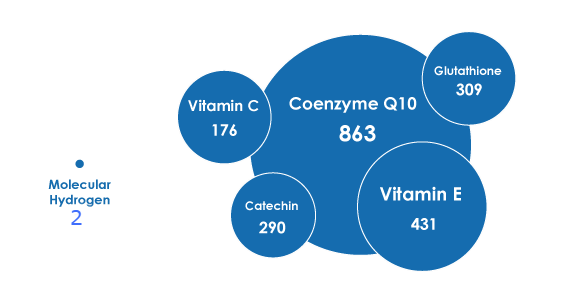
| 1. The most powerful anti-oxidative activity (176 times of vitamin C, 431 times of vitamin E, 863 times of coenzyme)
2. High penetration (it can pass through water-soluble, lipoid solubility , cell membrane due to small molecular weight) 3. Harmless to the human body 4. The ability to eliminate selectively only harmful oxygen free radicals 5. No accumulation in the body |
1. The most powerful antioxidative activity
1 Litres of KYK Higen Hydrogen Water is equal to the following: 176 times of vitamin C, 431 times of vitamin E, 863 times of coenzyme!
2. High penetration
Hydrogen is the smallest material in the universe and can reach mitochondria in the cell.
 ※ Vitamin C acts only in the blood, Vitamin E acts only on the cell membrane.
- Human cells consist of water and oil. Hydrogen dissolves in both water and oil, so it can reach the corners of the cell and effectively removes oxygen radical.
- There is a water channel in the human body that allows water to flow freely.
- The size of the water channel is 0.3 to 1.3 nanometers (One nanometer is one billionth of a meter)
- Vitamin C or beta 0 carotenes cannot pass through the water channel
- The size of the hydrogen molecule is 0.3 nanometers
→ It is the only substance that can remove harmful oxygen free radicals by effectively passing through both water and oil thereby penetrating water channels and cell membranes!
3. Harmless to the human body
In the case of hydrogen, it reacts only with oxygen radical.
It is naturally excreted through breathing and excretion due to its high diffusivity. In case of the absence of Oxygen free radicals to react, it gets excreted without any negative effects on the body.
4. It eliminates harmful oxygen free radicals selectively
– About 90% of diseases are related to oxygen free radical.
– As mentioned earlier, it reacts only with oxygen free radical as the most deadly component without reacting with active oxygen as the beneficial component.
| 1. Hydrogen water contains abundant hydrogen which selectively removes oxygen free radicals from the Human Body.
2. Suppresses inflammation in the cells. 3. Cerebral infractions were dramatically improved. 4. Reduction Effect of Oxidized fat. – In 2007, Summary of Paper by Professor Otashigeo
|
5. No accumulation in the body after taking too much
– Hydrogen does not accumulate in the body. It is naturally excreted through breathing and excretion due to its high diffusivity in case of the absence of Oxygen free radicals to react.
→ Considering all the advantages of hydrogen as above, Hydrogen (H2, H+) is the most ideal antioxidant and new material of everyone’s dream in the 21st century.
APHA and Drinking Water pH Standards
Understanding the American Public Health Association Position on Water pH
The American Public Health Association (APHA) recognizes that water pH is an important water quality parameter.
According to scientific water quality standards, pH can influence:
• Taste
• Odor
• Corrosion potential
• Mineral stability
• Water treatment efficiency
• Distribution system performance
Water that becomes excessively acidic may increase corrosion within plumbing systems. Water that becomes excessively alkaline may produce scaling and mineral deposition.
For this reason, most public water systems maintain pH within accepted drinking water ranges.
The Environmental Protection Agency (EPA) similarly identifies a recommended pH range of approximately 6.5 to 8.5 for public drinking water systems.
pH itself is not considered a contaminant. Rather, it serves as an important indicator of water quality and treatment performance.
In advanced water technologies such as electrolysis-based water ionizers, pH becomes only one of several measurable parameters. Other important characteristics include dissolved hydrogen concentration, oxidation-reduction potential, mineral content, filtration efficiency, and microbiological quality.
Researchers increasingly recognize that pH alone cannot explain the observed effects reported in many hydrogen water studies.
This distinction has become important in modern water science because emerging research suggests that dissolved molecular hydrogen may be responsible for many of the biological effects associated with hydrogen-rich electrolyzed water.
WHO Drinking Water pH Guidelines
What Is the Ideal pH for Drinking Water?
The World Health Organization (WHO) states that most drinking water falls within a pH range of approximately 6.5 to 8.5. This range is widely accepted globally because it supports water stability, taste, infrastructure protection, and overall water quality.
pH is a scientific measurement that indicates how acidic or alkaline a substance is on a scale from 0 to 14. A pH of 7 is considered neutral, values below 7 are acidic, and values above 7 are alkaline.
Natural water sources around the world typically fall within the WHO-recommended range. Rainwater, spring water, groundwater, and municipal drinking water may vary slightly depending on geology, mineral content, and environmental conditions.
The WHO recognizes that pH affects several important characteristics of drinking water, including taste, corrosion potential, mineral solubility, and treatment effectiveness.
Many naturally mineralized waters are slightly alkaline because they contain dissolved minerals such as calcium, magnesium, potassium, and bicarbonates.
Hydration remains the most important factor in water consumption. Whether water is neutral, slightly acidic, or slightly alkaline, maintaining adequate daily hydration is essential for overall health and wellbeing.
Modern alkaline water systems such as KYK Water Ionizers provide users with the ability to generate alkaline water while also producing purified water and acidic water for specialized applications.
The relationship between drinking water pH and human health continues to be investigated by researchers worldwide. However, it is important to understand that the human body tightly regulates blood pH within a narrow physiological range regardless of the pH of consumed foods and beverages.
The increasing interest in alkaline water is therefore focused not only on pH itself but also on mineral content, hydration properties, oxidation-reduction potential (ORP), and dissolved molecular hydrogen concentration.
Oxidation Reduction Potential (ORP) and Molecular Hydrogen
Why ORP Does Not Equal Hydrogen Concentration
One of the most misunderstood concepts in the alkaline water industry is oxidation reduction potential, commonly known as ORP.
Many consumers assume that a more negative ORP automatically indicates higher levels of dissolved molecular hydrogen. Scientific research demonstrates that this assumption is not always correct.
The graph illustrates an important scientific principle:
ORP is heavily influenced by pH.
As pH increases, ORP becomes more negative even when hydrogen concentration remains unchanged.
Researchers have demonstrated that increasing pH can create large ORP shifts without significantly changing dissolved hydrogen levels.
This means that ORP should not be used as the primary measurement of hydrogen concentration.
Instead, dissolved hydrogen concentration should be measured directly using validated hydrogen testing methods.
Modern hydrogen water science increasingly focuses on dissolved molecular hydrogen concentration because hydrogen is considered the primary biologically active component of electrolyzed reduced water.
This research has helped clarify many misconceptions that previously existed within the water ionization industry.
Today, leading hydrogen researchers generally recommend evaluating:
• Dissolved hydrogen concentration
• Hydrogen retention
• Water quality
• Mineral composition
rather than relying solely on ORP values.
Four Major Biological Effects of Molecular Hydrogen
How Molecular Hydrogen Works Inside the Human Body
Scientific research has identified four primary biological activities associated with molecular hydrogen.
Antioxidant Activity
Molecular hydrogen has been shown to selectively neutralize highly reactive oxidants while preserving beneficial signaling molecules.
Unlike many traditional antioxidants, hydrogen appears to demonstrate selective antioxidant activity.
Anti-Inflammatory Activity
Research suggests molecular hydrogen may influence inflammatory signaling pathways including NF-kB, TNF-alpha, ICAM-1 and related biological mediators.
Inflammation remains one of the most extensively researched areas in hydrogen medicine.
Cytoprotective Activity
Hydrogen appears to support cellular protection mechanisms by influencing pathways associated with cell survival and stress adaptation.
Researchers continue investigating how hydrogen may help cells respond to physiological stress.
Signal Modulation
Perhaps the most fascinating discovery is that hydrogen appears to function as a signaling modulator.
Rather than acting solely as an antioxidant, hydrogen may influence multiple cellular communication pathways involved in health and biological regulation.
These four biological properties explain why hydrogen research now spans hundreds of diseases and physiological systems.
Oxidation Reduction Potential (ORP) and Molecular Hydrogen
Why ORP Does Not Equal Hydrogen Concentration
One of the most misunderstood concepts in the alkaline water industry is oxidation reduction potential, commonly known as ORP.
Many consumers assume that a more negative ORP automatically indicates higher levels of dissolved molecular hydrogen. Scientific research demonstrates that this assumption is not always correct.
The graph illustrates an important scientific principle:
ORP is heavily influenced by pH.
As pH increases, ORP becomes more negative even when hydrogen concentration remains unchanged.
Researchers have demonstrated that increasing pH can create large ORP shifts without significantly changing dissolved hydrogen levels.
This means that ORP should not be used as the primary measurement of hydrogen concentration.
Instead, dissolved hydrogen concentration should be measured directly using validated hydrogen testing methods.
Modern hydrogen water science increasingly focuses on dissolved molecular hydrogen concentration because hydrogen is considered the primary biologically active component of electrolyzed reduced water.
This research has helped clarify many misconceptions that previously existed within the water ionization industry.
Today, leading hydrogen researchers generally recommend evaluating:
• Dissolved hydrogen concentration
• Hydrogen retention
• Water quality
• Mineral composition
rather than relying solely on ORP values.
Biological Mechanisms of Molecular Hydrogen
Molecular Hydrogen and Cellular Health
Hydrogen is no longer viewed simply as an antioxidant.
Modern scientific research demonstrates that molecular hydrogen may influence numerous biological systems simultaneously.
Researchers have reported interactions involving:
Oxidative Stress Regulation
Hydrogen selectively reduces harmful hydroxyl radicals and peroxynitrite while preserving beneficial reactive oxygen species involved in cellular communication.
Inflammatory Pathways
Studies have observed effects on TNF-alpha, NF-kB, IL-1, IL-6, IL-8 and related inflammatory mediators.
Mitochondrial Function
Hydrogen appears capable of influencing mitochondrial activity and cellular energy production.
Immune Regulation
Research has investigated hydrogen’s role in immune balance and cellular signaling.
Endoplasmic Reticulum Stress
Hydrogen has been studied for potential effects on cellular stress response mechanisms.
The remarkable feature of molecular hydrogen is its ability to affect multiple physiological pathways simultaneously while maintaining an excellent safety profile.
This systems-wide approach is one reason hydrogen has attracted increasing scientific attention worldwide.
Molecular Hydrogen Research Across Multiple Organ Systems
Scientific Evidence Across Diverse Biological Systems
Hydrogen research now spans virtually every major organ system.
Published studies have investigated hydrogen’s effects on:
Cardiovascular Health
Research has explored relationships between hydrogen and vascular function, oxidative stress, inflammation, and lipid metabolism.
Neurological Health
Scientists have investigated potential roles in cognitive function, brain health, neuroprotection, and healthy aging.
Respiratory Health
Hydrogen has been studied in relation to oxidative stress and inflammatory responses affecting respiratory tissues.
Digestive Health
Research includes investigations involving gastrointestinal function and digestive system health.
Metabolic Wellness
Numerous studies have examined glucose metabolism, insulin sensitivity, cholesterol regulation, and energy metabolism.
Exercise Performance
Athletes and sports scientists have investigated hydrogen’s role in recovery, fatigue reduction, and performance support.
Although research remains ongoing, the breadth of published studies demonstrates the growing scientific interest in molecular hydrogen as a wellness technology.
Hydrogen continues to be one of the fastest-growing areas of research in preventive health, sports science, nutritional medicine, and healthy aging.
Biological Mechanisms of Molecular Hydrogen
Molecular Hydrogen and Cellular Health
Hydrogen is no longer viewed simply as an antioxidant.
Modern scientific research demonstrates that molecular hydrogen may influence numerous biological systems simultaneously.
Researchers have reported interactions involving:
Oxidative Stress Regulation
Hydrogen selectively reduces harmful hydroxyl radicals and peroxynitrite while preserving beneficial reactive oxygen species involved in cellular communication.
Inflammatory Pathways
Studies have observed effects on TNF-alpha, NF-kB, IL-1, IL-6, IL-8 and related inflammatory mediators.
Mitochondrial Function
Hydrogen appears capable of influencing mitochondrial activity and cellular energy production.
Immune Regulation
Research has investigated hydrogen’s role in immune balance and cellular signaling.
Endoplasmic Reticulum Stress
Hydrogen has been studied for potential effects on cellular stress response mechanisms.
The remarkable feature of molecular hydrogen is its ability to affect multiple physiological pathways simultaneously while maintaining an excellent safety profile.
This systems-wide approach is one reason hydrogen has attracted increasing scientific attention worldwide.
Why Alkaline pH Alone Does Not Explain the Benefits of Electrolyzed Water
Scientific Evidence from Modern Hydrogen Research
One of the most important developments in water science is the recognition that alkaline pH alone may not account for the observed biological effects reported in electrolyzed reduced water studies.
Recent peer-reviewed reviews have concluded that:
• Dissolved molecular hydrogen is likely the primary active factor.
• Negative ORP is largely a consequence of dissolved hydrogen.
• Many historical claims regarding microclusters, active hydrogen, and altered water structure have been scientifically refuted.
• Molecular hydrogen remains the most scientifically supported explanation for observed biological effects.
This distinction is extremely important because it shifts the focus from simply producing alkaline water to producing hydrogen-rich water with measurable dissolved hydrogen concentrations.
Modern hydrogen water technologies therefore emphasize:
• High dissolved hydrogen levels
• Stable hydrogen retention
• Advanced electrolysis systems
• Scientific validation
rather than relying exclusively on pH measurements.
For consumers seeking evidence-based water technology, understanding the difference between alkalinity and hydrogen concentration is essential.
- hydrogen water studies
- molecular hydrogen research
- alkaline water science
- dissolved hydrogen benefits
- ORP explained
- WHO drinking water pH
- EPA water pH standards
- hydrogen rich water
- electrolyzed reduced water
- molecular hydrogen mechanisms
- hydrogen antioxidant research
- hydrogen inflammation studies
- hydrogen water clinical trials
Biological Mechanisms of Molecular Hydrogen
Molecular Hydrogen and Cellular Health
Hydrogen is no longer viewed simply as an antioxidant.
Modern scientific research demonstrates that molecular hydrogen may influence numerous biological systems simultaneously.
Researchers have reported interactions involving:
Oxidative Stress Regulation
Hydrogen selectively reduces harmful hydroxyl radicals and peroxynitrite while preserving beneficial reactive oxygen species involved in cellular communication.
Inflammatory Pathways
Studies have observed effects on TNF-alpha, NF-kB, IL-1, IL-6, IL-8 and related inflammatory mediators.
Mitochondrial Function
Hydrogen appears capable of influencing mitochondrial activity and cellular energy production.
Immune Regulation
Research has investigated hydrogen’s role in immune balance and cellular signaling.
Endoplasmic Reticulum Stress
Hydrogen has been studied for potential effects on cellular stress response mechanisms.
The remarkable feature of molecular hydrogen is its ability to affect multiple physiological pathways simultaneously while maintaining an excellent safety profile.
This systems-wide approach is one reason hydrogen has attracted increasing scientific attention worldwide.
Oxidation Reduction Potential (ORP) and Molecular Hydrogen
Why ORP Does Not Equal Hydrogen Concentration
One of the most misunderstood concepts in the alkaline water industry is oxidation reduction potential, commonly known as ORP.
Many consumers assume that a more negative ORP automatically indicates higher levels of dissolved molecular hydrogen. Scientific research demonstrates that this assumption is not always correct.
The graph illustrates an important scientific principle:
ORP is heavily influenced by pH.
As pH increases, ORP becomes more negative even when hydrogen concentration remains unchanged.
Researchers have demonstrated that increasing pH can create large ORP shifts without significantly changing dissolved hydrogen levels.
This means that ORP should not be used as the primary measurement of hydrogen concentration.
Instead, dissolved hydrogen concentration should be measured directly using validated hydrogen testing methods.
Modern hydrogen water science increasingly focuses on dissolved molecular hydrogen concentration because hydrogen is considered the primary biologically active component of electrolyzed reduced water.
This research has helped clarify many misconceptions that previously existed within the water ionization industry.
Today, leading hydrogen researchers generally recommend evaluating:
• Dissolved hydrogen concentration
• Hydrogen retention
• Water quality
• Mineral composition
rather than relying solely on ORP values.
 WhatsApp us